
Getting Ready to Explain
Having now had a shower I thought it would rev me up for this depiction of ‘How beguiled disdain sways a King’s regard’ but it has put me somewhat off. It must have been my watching boring television before starting that I have now lost my strive or focus, oh well, I’ll get it back.
In one sentence, the title notes how the King’s consideration can be changed by a good deceiving defense from one who is normally looked down upon and scorned. The King’s regard was swayed by the slave who in reading the Sonnet you will understand. As naturally a slave would be looked down upon and considered beneath a King’s notice, the slaves misleading and capturing words in his defense lead the King to see him in a different light.
Thus, the man stands accused of treachery but the enslaved man bids to change the King’s mind in his last attempt before being sent to death. The word ‘sway’ has a pun attached as a King is associated with his ruling as a sovereign and therefore, the enslaved man is trying with his misleading words to rule the regard of the King. These words must be so compelling that they can have such a sovereign effect on the King’s regard that he might consider the enslaved man’s plea to be freed.
One more thought, ‘beguiled disdain’ means to say that the man has been deceived into being below everyone else by the man who shackled him with accusation. The enslaved man was wrongly accused and his strong will of words sways the King’s regard into believing he was deceived into being enslaved by beguiling words. Let us now off to the Sonnet…
Fire and Thorns
The Sonnet begins with the enslaved man appearing before the King for his last bid for freedom. He speaks with authority (1.1) and eagerness as he proclaims the words “Hear me speak”. Usually if a man was guilty his braveness in speech would not be so content but this man does spit out the truth as if his brave words were on fire with determination.
The first line has a simile with a drawn out effect that is like saying “My words are like fire” and the enslaved man would have a reason to have fuming words as he was wrongly accused. The man is very intelligible and smart in his speech as he explains his words prick just like thorns would (1.2).
‘Sharp wit’ combined with the simile of thorns would indicate that the enslaved man is very smart and witty as he is so sharp to answer with the truth. Carrying on the parenthetical illustration of a thorn encrusted tree of wit (1.3) he furthers his strength that he is not guilty by saying “The thought of being put to death does not hold my tongue any less of the truth I speak it”.
Drawing once again a parable, a man in the wrong would be more inclined to beg forgiveness where a man who is in the true will not stoop to forgiveness but rather put forth his truth. A ‘brier’ is a bush that has thorns upon it and to this enslaved man, the brier is his tongue and witty words that do not stop or hinder because of the thought of prosecution and death.
The thought of death (Shown as the possibility of wounds) do not worry the enslaved man as he considers himself disdained by belief and thus, already wounded by accusation and weakened by it (1.4). Therefore, the man has nothing to lose in telling the truth and he doesn’t fear being mortally wounded as he has been wounded and weakened by other means.
Being disdained can bring a nobleman to nothing and he feels that he is already dead in the eyes of the public who believe him to have committed treason. There is a portion of alliteration in both (1.3) and (1.4) but mostly in the latter. Figurative speech is also added with the bleeding of the brier.
Chains and Fair Liege
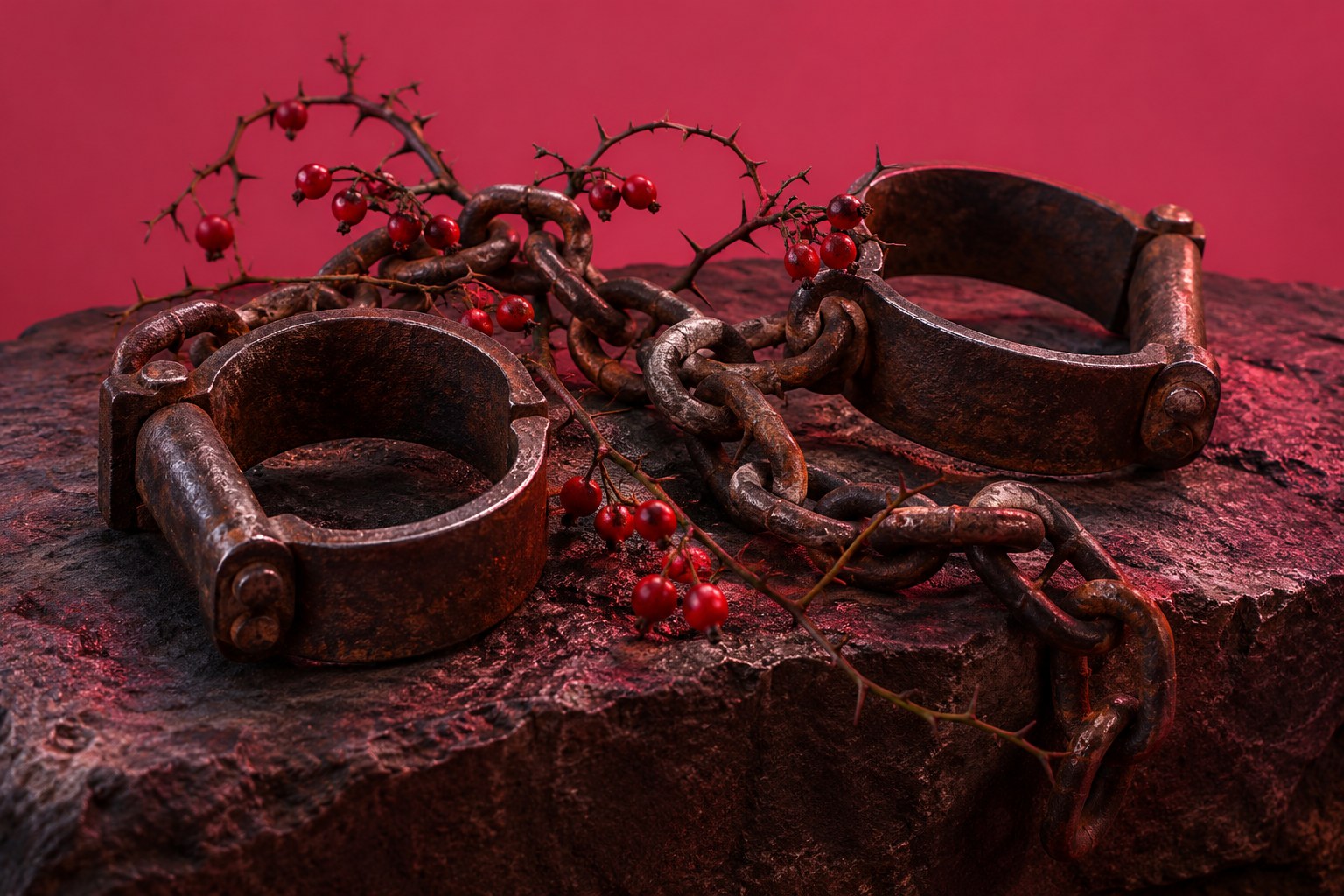
The second quatrain moves slightly from his justifying his innocence with strong words to sharing with the King his idea that the shackles and chains that enslave him do make his truth seem prejudiced (1.5). If the man came to the King as a commoner or a nobleman he would be looked upon differently to the disdaining shown with the tethering.
“Fair liege” he speaks to the King showing his flattery and persuasion displaying his hope that the King will be fair and honorable. The respect of the King as his liege shows his loyalty and it also shows that the enslaved man still wishes to be seen as a voice, as a vassal to the Lord. These two words are persuasive attempts to beguile the King with peppered words but words of noble truth that will hopefully free him.
The enslaved man believes that his being shown before him in a disdained way shall alter the King’s usually just thinking and he notes “This unfairness is the finer case of my mentioning” (1.6). There is a perceivable antithesis on the words ‘truth’ and unjust’ in this line showing the contrast that places confusion on the King’s judgment and disdain upon the enslaved man. Therefore, the man hopes that the prominent King will judge him as fair as a nobleman and consider his plight fairly.
Phoebus the Sun King
In line (1.7) the King is depicted as Phoebus to which the enslaved man used his sharp wit once again to flatter the King. Phoebus being the god of the sun, the enslaved man sees the King as a glowing man, reflective upon his intelligence, prudence and prosperity in common sense.
Using figurative speech, the enslaved man hopes he can confide in the King to see the truth and release him from bonds. As the sun is extremely hot, the enslaved man entrusts his back to it being at his most disadvantageous (In chains) and he hopes the King will not burn his back by sending him to death (1.8).
The man can do nothing but expose himself weakly to the King in hopes that he won’t be pretentious and send him to death as an example to all that enforce treachery. He hopes the King is not as shallow as to be so pompous and lay a claim on the enslaved man’s life.
The Closing Argument
The third quatrain moves to a wrapping up of his solvency and as in a court of these days, the closing argument is something more admirable. The man has moved from speaking his strong will to condemning himself to death if the truth does not prosper for the King (1.9). The enslaved man speaks “If my strong word does not make up your mind for you then I stand accused of my denial that I had committed treason” (1.10).
The word ‘Disgression’ was created by myself and it simply means a sincere denial and strong opposing of an allegation. Thus, the enslaved man who is not yet judged speaks of his succumbing to a bad verdict if his strong truth and denial of the accusation does not fall on the King’s ear.
“I do not stand accused of treason” the man says “But if convicted, I stand accused of denying a lie and accepting the truth”. The word ‘accused’ is accented so that it holds for three syllables in respect to the meter instead of two syllables. The word ‘resolve’ also indicates the need for his release in which an antithesis could be considered for ‘Resolve’ and ‘accused’.
The finishing speech goes on to add that if the balance of truth weighs more to the wronged sentencing than to his dismissal of charges he wants the King not to show any remorse (1.11-1.12). The use of the word ‘poised’ could also be considered as a pun to poison the truth as did the conspirator. His truth being poisoned by his accused crime of treason and his disdain of being in shackles before the King.
There is also a typical antithesis between ‘Aggrieved’ and ‘Absolved’ where one means legally wronged to face being committed and the other is freeing of his committed state. If the King doesn’t see that the truth has been poisoned by distortion of truth then the enslaved man wishes him to yield to the power to put him to death. “If you find me guilty” the man asks “Do not heal my wounds with pity and a lesser sentence but yield me to the law and hang me to death”.
There is a play on words intended on the words ‘absolved’, ‘salve’ and ‘resolve’ where they have the same play on the word solve and some significance is in each meaning. When you move to the word ‘resolve’ in line (1.12) there is another pun which breaks the word into re-solve.
Thus, he does not want the King to give him a second trial or show any remorse. He only wants hard justice done, not a soft injustice that would see a lenient verdict of a lesser crime.
The Final Couplet
The final couplet has the enslaved man questioning the system of law and truth in its entirety. He asks “Where is the proof that I have committed treason or any crime”. The enslaved man also notes that a lie could easily mislead truth and thus, distortion of truth is once again brought into play, something very common in today’s courtrooms.
“For what reason does truth have in this verdict if all you hear are lies” the man speaks, “That you can consider me to death without first having proof with your accusations”. He speaks of the unfairness of the claim and the injustice of the royal court. The actual verdict is not reached but that is just a compelling last speech from the enslaved man before his verdict from the King is resolved.
I would tend to think that his strong word of truth freed him from his suspected treason… Just a couple more notes. There is an antithesis on ‘Lies’ and ‘truth’ with parenthetical and rhetorical stresses. There is also a stressing on the word ‘Considered’ in the last line in which the line should read ‘That I to death considered without considered’ and thus creating a play on words.
“If you find me more guilty than not” he utters “And if you believe I committed treason, then by all means”. Distortion of truth, misleading the King and a strong cry for justice is what this speech is all about.
Another Sonnet Interrupts
Now that the deliberation is complete of fine explanation I shall another Sonnet place in these pages. It seems that each time I have to write for another Sonnet of late I write a new one and then I feel a little rushed to depict the first Sonnet in words.
Now I am up to my second Sonnet but once again I have to pause today and forget explanation until tomorrow as it is 7:21 a.m. Let us hope that I will have enough time tomorrow to depict this newest Sonnet but I will probably hit another idea for a Sonnet and then off I go. This as I note is an idiosyncrasy of a Biorhythm Cycle.
To come up with three great Sonnets in the triple negative days (Being the worst in the cycle) is fairly peculiar. However, in a good light on the matter, I have written three Sonnets in the space of six nights which on average is one each two days. However, on a lesser note, I know that I can’t keep this high pace up and soon I will decline with thought but I know that I will not hit writer’s block bottom again for a long time.
The Medieval Epic Sonnets
Lately only historical and medieval epic thoughts have been coming to mind which probably states that I should serve a name for those Sonnets just like I did for the lost years Sonnets. They are distinguishable because they evolve around medieval times, Kingly affairs, a warrior on an errant journey or something to do with a castle or people. Maybe I should label them ‘The Medieval Epic Sonnets’ and labeled in a desired chronological order. These last three Sonnets would fit that category of these such Sonnets and much more before this month. Regardless, let us now to this new Sonnet…
Like crumbling walls varlets tether my rise
Few men breathe fresh with this new heir about,
Fewer still fain whet their patriot tongues,
This nation’s belly with dastards full-stout,
Harboring mettle that pierceth King’s lungs,
Give a man leave and watch his trunk oblige,
Give a man duty and watch his defeat,
And save bent knee shall not swear to his liege,
Give a King luck and bold toss him his seat,
How these hearts still mock when to gallows sent,
Wherefore sways to my sway make no amends,
Rive firm fingers and they shall as soon point,
Show them early graves and make Kings villains,
Words to strokes make enemies of allies,
And strokes to words make lief men civilized,
Pushups at Dawn
The time now stands at 7:34 a.m. and as my eyes tire all the more I must attend myself to sleep. Let me just note that I have not been to the Gym for a while now but I did complete 43 straight pushups without first warming up and then completing 7 more reps to make it ever. With this I done some sit-ups having only done 45 but having them do an effective job. My body is getting skinnier due to my imprudent eating habits save for the lack of food availability because of the amount my mum buys. Now I must be off so do not slacken until next I flick at thee.

Diary Of A Mad Chaos is a daily diary written from March 1996 until today, of which individual books and book series have been created, namely “The Lost Years” an exploration of young, entwined love, the “Wubao In China (猎艳奇缘)” book series which provides an extensive comparative analysis of the cultural differences between Eastern and Western societies, and the book titled “Foreigner (华人)” an exploration of race relations in Australia.