
Reflections on Polymatrix, July 7 to September 14, 2026

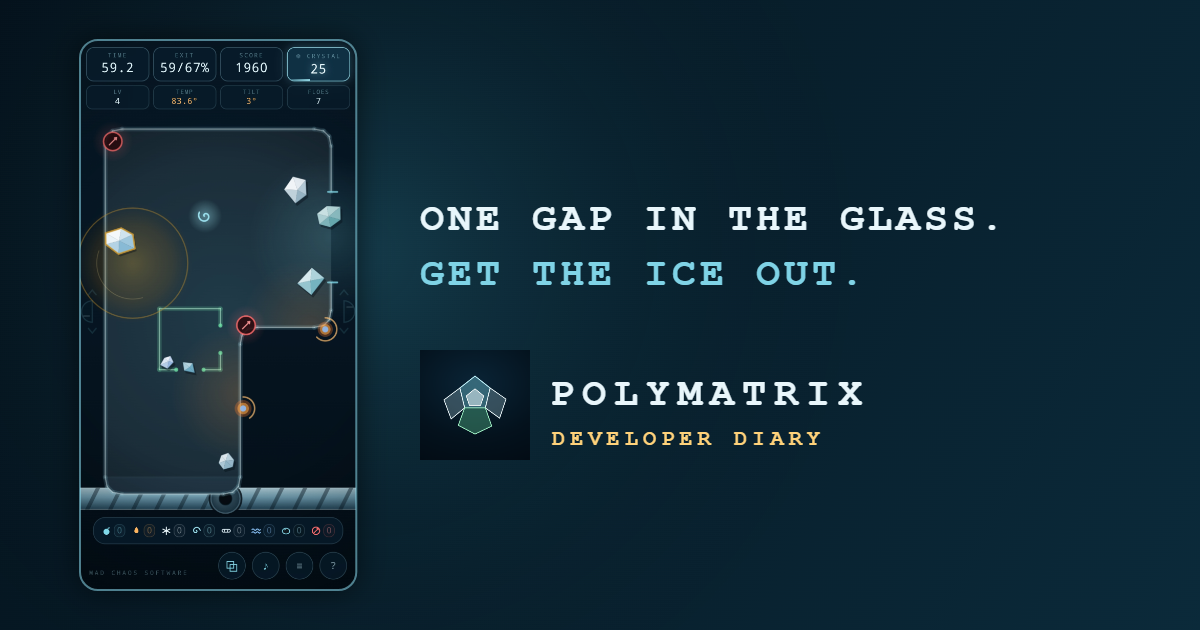
Polymatrix started as a shower thought: could Fable 5 make polygon ice break up under your finger on a phone? Ten weeks later it was a published physics puzzle on Google Play, with 100 glass chamber variants, a difficulty curve charted out to level 94, mini games, a tutorial and twelve closed testers behind it. This is what I’d tell myself on July 7.
What was harder than it looked
- Compute is a budget, not a tap. Fable 5 built the first versions beautifully, but it once spent thirty minutes and gave me nothing back, and a single tutorial prompt took 60% of my usage. Smaller asks, one feature at a time, got more done than giant lists.
- Keep one version line. I once built three versions on top of an old copy and had to merge two games back together. Always know which build is the newest before you start talking changes into it.
- The browser is not the phone. The tutorial worked in the browser and broke on mobile. Test on the device the player will actually hold.
- Seeing is believing. Claude sent screenshots of irregular flasks at level 40, but I played ten or fifteen levels and never saw one. The fix was a new mechanic, the compiler, that makes them appear from level three.
- Store rules are picky. Polymatrix was rejected because the launch icon was a bottle while the store icon was a pentagon. Use one icon everywhere.
What was easier than expected
- Getting to Android. I expected to fight Android Studio. Instead Claude handed me a zip with a Capacitor APK project and the commands to run.
- Turning ideas into mechanics. Lance’s spin-the-bottle idea went into the game the same day. Hot beads, the jellyfish starfish and the hot water bubble all started as sentences talked into my phone.
- Finding testers. Facebook closed testing groups took me from two testers to twelve in about two days, because people trade testing for testing.
Things I didn’t know going in
- Difficulty needs numbers. The Tuning and Balance charts showed exactly where the game became unfair: an exit quota that turned impossible after level 34, an exit target that was too low at 55%, and first levels that were just an empty glass.
- Testers tell you what’s missing. One tester said there were too many buttons. That became the level zero tutorial and a power-up bar that hides itself.
- Analytics and ads need their own testing. Analytics took twenty minutes to show events, and the game once started while an ad was still playing.
Advice for anyone starting an app
- Build a way to see what the player sees: a console-log build, a stats viewer, a session viewer. Tune from data, not feel.
- Let the people around you shape it. A seven-year-old’s idea is as good a design document as any.
- Decide early what kind of game you want to give people. I didn’t want Polymatrix to be pay to win or laden with ads, and that made later decisions easy.
- Expect the last two weeks to be closed testing, bug hunts and store paperwork rather than new features, and enjoy them anyway.

Diary Of A Mad Chaos is a daily diary written from March 1996 until today, of which individual books and book series have been created, namely “The Lost Years” an exploration of young, entwined love, the “Wubao In China (猎艳奇缘)” book series which provides an extensive comparative analysis of the cultural differences between Eastern and Western societies, and the book titled “Foreigner (华人)” an exploration of race relations in Australia.